Every Tote Saved Is a Win for the Planet
IBC reconditioning is not just good business. It is one of the most impactful forms of industrial recycling available today. Here is how Rochester IBC is leading the charge.
Partner With Us on Sustainability
Fill in the details and we'll get back to you within 24 hours.
The Hidden Environmental Cost of Single-Use IBCs
An Intermediate Bulk Container is an engineering marvel: a 275-gallon high-density polyethylene bottle nested inside a welded galvanized steel cage, mounted on a pallet, and designed to safely transport everything from food-grade liquids to industrial chemicals. Manufacturing a single new IBC tote requires approximately 20 pounds of virgin HDPE plastic, 30 pounds of steel, and a wooden or composite pallet. The production process consumes significant energy — from extracting and refining petroleum for the plastic, to smelting iron ore for the steel, to the injection molding and welding that brings it all together.
Despite this intensive manufacturing process, many businesses treat IBCs as single-use items. After one fill-and-ship cycle, containers are sent to waste haulers who crush them and deposit them in landfills. In the United States alone, millions of IBCs are discarded annually. The polyethylene bottles take an estimated 400 to 1,000 years to decompose. The steel cages, while technically recyclable, are often contaminated and sent to general waste rather than metal recyclers. The result is a massive, ongoing flow of reusable industrial materials into the ground — materials that could serve businesses for years if properly managed.
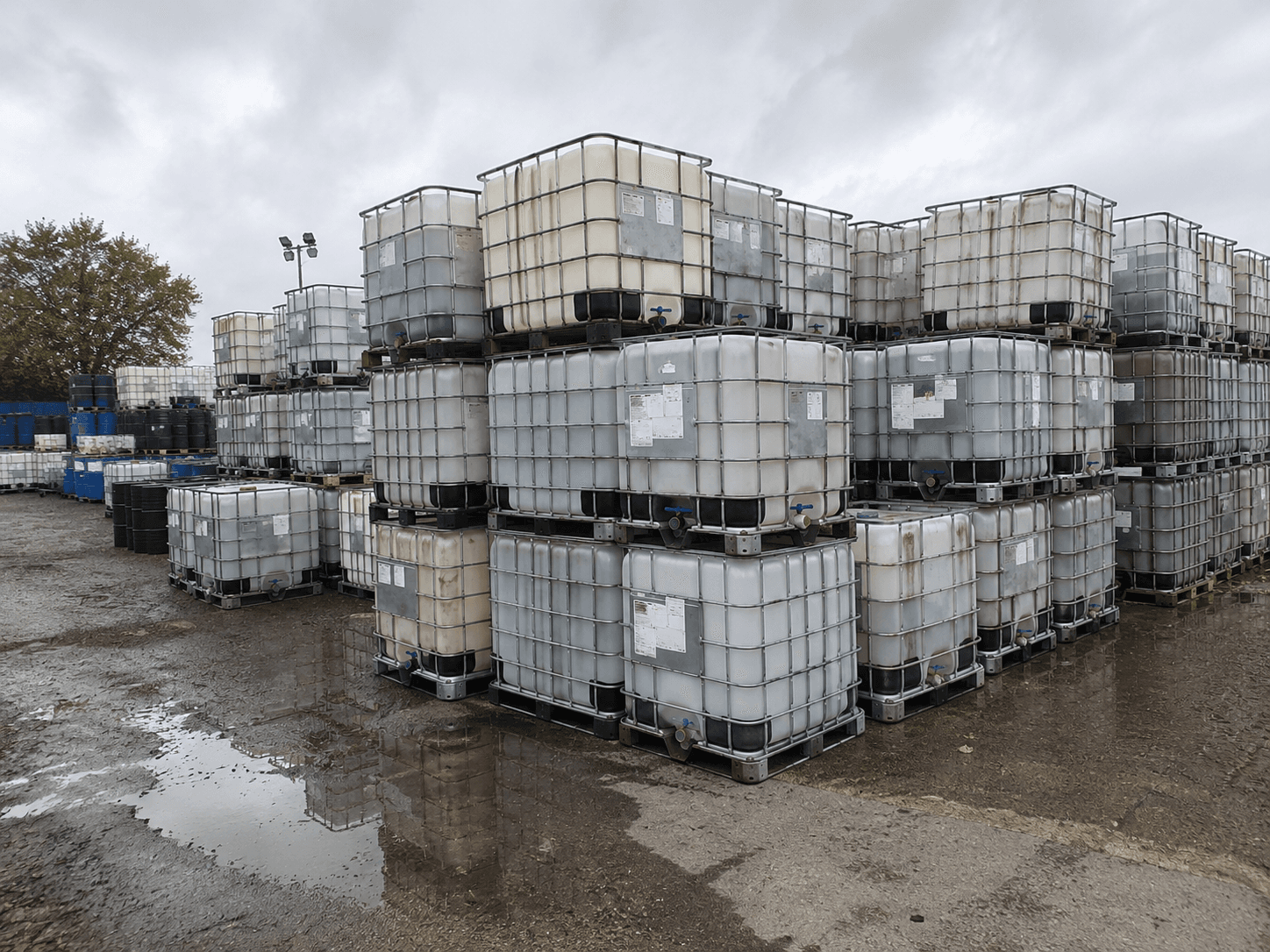
How IBC Reuse Creates a Closed-Loop System
The circular economy replaces the take-make-dispose model with a system where materials are continuously reused at their highest value. IBC totes are ideal candidates for this approach.
Collection
We pick up used IBC totes directly from businesses across the region. Instead of paying a waste hauler, our partners receive fair value for their empty containers and eliminate disposal costs entirely.
Inspection
Every collected tote undergoes a thorough multi-point inspection. We evaluate the polyethylene bottle for cracks, UV degradation, and chemical staining. We check the steel cage for corrosion, bent frames, and weld integrity.
Reconditioning
Totes that pass inspection are professionally cleaned using high-pressure wash systems, sanitized according to their intended reuse application, fitted with new valves and gaskets as needed, and re-labeled for their next life cycle.
Redeployment
Reconditioned IBCs are sold to businesses that need reliable bulk containers. The cycle begins again, with each tote potentially serving five or more use cycles before it is finally broken down and recycled at the material level.
Understanding the Full Circular Loop
The circular economy model for IBC totes operates on three concentric loops, each representing a different level of material recovery. The innermost loop is reuse: a tote is cleaned and put back into service with minimal intervention. This is the highest-value loop because it requires the least energy and preserves the container in its most useful form. The middle loop is reconditioning: the inner bottle is replaced while the cage and pallet are retained. This extends the life of the steel and wood components by 3-5x. The outermost loop is material recycling: the tote is fully disassembled and each material — HDPE plastic, galvanized steel, and wood — is sent to the appropriate recycling stream to be transformed into new products.
At Rochester IBC, we prioritize the innermost loops first. If a tote can be reused as-is after cleaning, that is the best outcome. If the bottle needs replacement, we recondition it. Only when a container has truly reached end-of-life do we move to the outermost loop of material recycling. This hierarchy — reuse first, recondition second, recycle last — ensures that every container delivers maximum value before its materials are transformed into something new.
Our Environmental Impact
Less energy required to recondition an IBC compared to manufacturing one from virgin materials
Of combined plastic and steel diverted from landfills for every single IBC tote we recondition
Average number of use cycles a well-maintained IBC tote can complete before end-of-life recycling
Minimum estimated decomposition time for HDPE plastic in a landfill — every diverted tote matters
Slashing Carbon Emissions, One Container at a Time
The carbon footprint of manufacturing a new IBC tote is substantial. Producing the HDPE plastic bottle alone requires petroleum extraction, transport to a refinery, cracking into ethylene, polymerization, and finally injection molding — a chain of processes that generates an estimated 2.5 to 3.5 kg of CO2 per kilogram of HDPE produced. For a typical 9 kg IBC bottle, that translates to roughly 22 to 32 kg of CO2 just for the plastic component. Add steel cage production (approximately 1.8 kg of CO2 per kg of steel), pallet manufacturing, assembly, and shipping from the factory, and the total carbon footprint of a single new IBC can exceed 75 kg of CO2 equivalent.
Reconditioning an existing IBC, by contrast, requires a fraction of this energy. Our wash systems use heated water efficiently, our inspection is manual and low-energy, and replacement parts (new valves, gaskets, labels) represent a tiny fraction of the materials in the original container. By our estimates, reconditioning an IBC generates less than 10% of the carbon emissions associated with manufacturing a new one. For every thousand totes we recondition, we prevent approximately 65 to 70 metric tons of CO2 from entering the atmosphere. Over the course of a year, this adds up to a meaningful reduction in the industrial carbon footprint of the Rochester region.
Expanded Carbon Lifecycle Analysis
To fully understand the carbon impact of IBC reconditioning, we need to examine the complete lifecycle of a container from cradle to grave versus cradle to cradle. In a linear (single-use) model, the lifecycle looks like this: petroleum extraction and transport (8-12 kg CO2e), refining and polymerization (15-22 kg CO2e), injection molding and cage fabrication (10-15 kg CO2e), assembly and quality testing (2-3 kg CO2e), transportation to customer (5-10 kg CO2e), single use, transportation to landfill (3-5 kg CO2e), and decomposition emissions over centuries. The total one-way carbon cost: 43-67 kg CO2e per container, per use.
In a circular (reconditioning) model, the initial manufacturing carbon cost is the same for the first use. But for each subsequent use cycle achieved through reconditioning, the incremental carbon cost drops to approximately 5-8 kg CO2e — the energy for washing, inspecting, replacing fittings, and transporting the reconditioned container. Over five use cycles, the per-use carbon cost drops from 43-67 kg CO2e to approximately 13-23 kg CO2e, a reduction of 60-70%.
When a tote finally reaches end of life, the recycling of its materials recovers additional carbon value. Recycled HDPE requires roughly 70% less energy to process than virgin resin, and recycled steel saves approximately 74% of the energy needed for primary steel production. These downstream savings further reduce the lifecycle carbon footprint of every tote that passes through our facility.
Responsible Water Use in Our Cleaning Process
Cleaning IBC totes requires water, and we take that responsibility seriously. Our reconditioning facility uses high-pressure, low-volume wash systems that maximize cleaning effectiveness while minimizing water consumption. Compared to the water required to produce virgin HDPE (which demands significant water inputs during petroleum extraction, refining, and polymerization), washing and reusing an existing container consumes a fraction of the total water footprint.
All wash water from our facility is captured and treated before discharge, in compliance with local wastewater regulations. We continuously evaluate our wash protocols to identify opportunities to reduce water use further — whether through optimized nozzle configurations, water recycling within our wash system, or pre-treatment methods that reduce the number of rinse cycles required.
High-Pressure, Low-Volume Systems
Our wash equipment delivers powerful cleaning at significantly reduced water volumes compared to conventional flood-wash approaches.
Wastewater Treatment Compliance
Every drop of wash water is captured and treated to meet or exceed local discharge standards before leaving our facility.
Continuous Improvement
We regularly audit and optimize our water usage, investing in technology and process refinements to push consumption even lower.
Water Footprint Comparison
Keeping Industrial Packaging Out of the Ground
Landfill diversion is not an abstract metric for us — it is the core of what we do. Every IBC tote that enters our facility is one that was headed for disposal. When we recondition it and send it back into service, that container stays out of the landfill for another full use cycle. When a tote has reached the end of its structural life and cannot be safely reconditioned, we do not simply discard it. We disassemble it into its component materials: the polyethylene bottle is separated from the steel cage, the valve assembly is removed, and the pallet is assessed for reuse or recycling.
The HDPE bottles are sent to plastic recyclers who grind them into flake and pelletize them for use in new plastic products — drainage pipes, plastic lumber, automotive parts, and other durable goods. The galvanized steel cages are sent to metal recyclers where the steel is melted down and recast. Even the wooden pallets are either repaired for continued use or chipped and repurposed as landscape mulch or biomass fuel. Through this comprehensive approach, we achieve near-total material recovery. The amount of material from our facility that ends up in a landfill is effectively zero.
Ground into flake, pelletized, and remanufactured into durable plastic products
Sent to metal recyclers for melting and recasting into new steel products
Repaired for reuse or chipped into landscape mulch and biomass fuel
New IBC vs. Reconditioned: The Environmental Cost
When you choose a reconditioned IBC tote over a new one, the environmental savings are dramatic across every measurable dimension.
Supporting Your ESG and Sustainability Disclosures
Environmental, Social, and Governance (ESG) reporting has become a critical requirement for businesses of all sizes. Investors, regulators, customers, and employees increasingly demand transparency about a company's environmental impact. Partnering with Rochester IBC provides tangible, documentable contributions to your ESG metrics.
For every IBC you purchase reconditioned rather than new, we can provide documented data on: the weight of virgin materials avoided (plastic and steel), the estimated CO2 emissions prevented, the gallons of water conserved, and the pounds of material diverted from landfill. These data points map directly to standard ESG frameworks including GRI (Global Reporting Initiative), SASB (Sustainability Accounting Standards Board), and CDP (formerly Carbon Disclosure Project).
We provide quarterly sustainability reports to our partnership-tier customers that summarize all environmental metrics associated with their IBC activity. These reports are formatted for direct integration into annual sustainability disclosures, corporate responsibility reports, and investor communications. Your purchasing decisions become a documented, quantified part of your environmental story.
GRI-Compatible Metrics
Our reporting aligns with Global Reporting Initiative standards, providing waste diversion, emissions reduction, and resource conservation data.
Quarterly Sustainability Reports
Partnership-tier customers receive detailed quarterly reports summarizing all environmental metrics from their IBC reconditioning activity.
Carbon Offset Documentation
We calculate and document the CO2 equivalent savings for every container reconditioned, providing verified data for carbon reporting.
Supply Chain Transparency
Full traceability of every container through our facility, documenting prior contents, reconditioning steps, and material recovery outcomes.
Our Environmental Policy Statement
Rochester IBC is committed to operating in a manner that minimizes environmental impact, conserves natural resources, and contributes to the sustainability of our industry and community. This commitment is reflected in every aspect of our business, from the services we offer to the way we manage our facility.
We pledge to:
- Prioritize reuse over recycling: We will always seek to recondition and reuse IBC totes before resorting to material recycling. Keeping containers in their highest-value form for as long as possible is the most environmentally effective approach.
- Achieve near-zero waste: We will maintain comprehensive material separation and recycling programs that prevent virtually all waste from our facility from reaching landfills.
- Minimize water consumption: We will invest in water-efficient cleaning technologies and continuously optimize our wash protocols to reduce water use per container.
- Reduce carbon emissions: We will optimize transport routes, maintain efficient facility operations, and select energy-efficient equipment to minimize our operational carbon footprint.
- Comply with all regulations: We will meet or exceed all applicable environmental regulations, including wastewater discharge standards, air quality requirements, and hazardous materials handling protocols.
- Measure and report transparently: We will track key environmental metrics, set improvement targets, and report our performance honestly to our customers, partners, and community.
- Support our customers' sustainability goals: We will provide the data, documentation, and partnership services that help our customers achieve their own environmental targets.
Third-Party Audit Results
We believe in accountability. Our environmental performance is periodically assessed through independent reviews and compliance audits to verify our claims and identify improvement opportunities.
Wastewater Compliance
All wash water discharge is tested and documented to demonstrate full compliance with Monroe County and New York State wastewater regulations. Audit results consistently show discharge quality well within permitted limits.
Material Recovery Rate
Independent assessments of our waste stream confirm a material recovery rate approaching 99%. Virtually all materials entering our facility are either reused, reconditioned, or recycled through documented channels.
Emissions Verification
Our carbon savings calculations are based on industry-standard lifecycle assessment methodologies and have been reviewed for accuracy and consistency with published emissions factors for HDPE and steel production.
Safety and Handling
Our facility operations are audited for compliance with OSHA workplace safety standards, proper chemical handling procedures, and environmental health requirements. Results confirm a strong safety culture.
Quality Process Review
Our reconditioning process has been reviewed against industry best practices for IBC cleaning, inspection, and reconditioning. Findings confirm that our protocols meet or exceed the standards set by leading reconditioning operations.
Customer Satisfaction
Periodic customer surveys and feedback analysis confirm high satisfaction with product quality, delivery reliability, and environmental documentation. Our repeat customer rate exceeds industry averages.
Sustainability Roadmap: 2025-2030
Our commitment to sustainability is not static. We have set ambitious goals for the next five years to deepen our environmental impact and raise the bar for our industry.
Water Recycling System
Install a closed-loop water recycling system in our wash bay that captures, filters, and reuses wash water, targeting a 40% reduction in fresh water consumption per container.
Solar Energy Installation
Deploy rooftop solar panels at our Commerce Drive facility to offset a significant portion of our electricity consumption with renewable energy, targeting at least 30% of facility power from solar.
Electric Fleet Transition
Begin transitioning our local delivery fleet to electric or hybrid vehicles, starting with our shortest-route trucks. Target: 25% of local deliveries by electric vehicles within two years.
Carbon Neutral Operations
Achieve carbon-neutral status for our facility operations through a combination of emissions reductions, renewable energy, and verified carbon offset purchases for any remaining emissions.
Industry Standards Leadership
Work with industry organizations to develop and promote standardized sustainability metrics for the IBC reconditioning sector, raising the bar for environmental performance across the industry.
True Zero Waste Certification
Achieve third-party certified TRUE (Total Resource Use and Efficiency) Zero Waste certification for our facility, validating that 100% of our waste streams are diverted from landfill through documented reuse and recycling channels.
Environmental Impact in Action
Real-world examples of how our reconditioning services have delivered measurable environmental benefits for our customers and the Rochester region.
Regional Food Processor Partnership
A large food processing facility in the Rochester area was disposing of approximately 200 IBC totes per quarter — sending them to a waste hauler at a cost of $15 per unit. By partnering with Rochester IBC, they now sell their used totes to us for fair market value and purchase reconditioned containers at a 50% discount versus new. The environmental impact: over 800 totes diverted from landfill annually, representing 40,000 pounds of material saved and an estimated 60 metric tons of CO2 avoided.
Chemical Distribution Fleet Management
A chemical distribution company managing a fleet of 500+ IBCs was struggling with inconsistent reconditioning quality from their previous supplier. After switching to Rochester IBC, they achieved a 95% tote reuse rate (up from 70%), dramatically reducing new container purchases. The environmental impact: 150 fewer new IBCs purchased per year, saving an estimated 7,500 pounds of virgin plastic, 11,250 pounds of new steel, and approximately 11 metric tons of CO2.
Farm Cooperative Container Program
An agricultural cooperative in the Finger Lakes region needed affordable bulk containers for fertilizer and water storage but was buying new IBCs at premium prices. We established a supply program providing Grade B reconditioned totes at 55% below new pricing. Over three years, the cooperative has purchased over 300 reconditioned containers, saving 15,000 pounds of plastic and 22,500 pounds of steel from virgin production.
Damaged Container Material Recovery
A manufacturing plant contacted us after accumulating over 100 heavily damaged IBCs that their waste hauler refused to accept. These containers were too damaged for reconditioning but contained valuable materials. We disassembled every unit, recovered all HDPE plastic, steel, and usable pallets, and directed each material to appropriate recycling channels. Total material recovery: 98.5%. Landfill contribution: less than 75 pounds from the entire batch.
Our Path to Zero-Waste Operations
Rochester IBC is committed to eliminating waste from our own operations, not just our customers' supply chains. At our 145 Commerce Drive facility, we have implemented comprehensive waste reduction protocols that cover every aspect of our business:
- Full material separation: Every end-of-life IBC is disassembled into its component materials. Nothing goes to general waste that can be recycled or repurposed.
- Parts reuse: Valves, caps, gaskets, and cage components that are still in good condition are cleaned and reused, reducing the need for new replacement parts.
- Efficient logistics: Our transport routes are optimized to minimize empty miles. When we deliver reconditioned totes to a customer, we pick up used totes on the same trip whenever possible, reducing fuel consumption and emissions.
- Office and facility practices: From LED lighting throughout our warehouse to digital documentation that minimizes paper use, sustainability extends to every corner of our operation.
- Vendor accountability: We work with suppliers and service providers who share our commitment to waste reduction and environmentally responsible practices.
Strengthening Rochester's Green Economy
Rochester has a proud industrial heritage, and Rochester IBC is helping to write its next chapter — one where manufacturing and sustainability go hand in hand. By providing local businesses with an affordable, environmentally responsible alternative to buying new containers, we help them reduce operating costs while shrinking their environmental footprint. This is not charity; it is good economics that happens to be great for the planet.
Our operations create skilled jobs in the Rochester community — from reconditioning technicians and logistics coordinators to quality inspectors and customer service specialists. We hire locally, train extensively, and pay fairly. Every container we process supports Rochester's workforce and keeps economic activity within the region rather than sending it to distant manufacturers.
Every position at Rochester IBC is filled locally. Our team members live in and contribute to the Rochester community, and their wages circulate through the local economy.
We prioritize Rochester-area suppliers for everything from truck maintenance to office supplies, keeping our spending within the community whenever possible.
By offering affordable reconditioned IBCs, we help Rochester manufacturers and distributors reduce costs without compromising on quality or sustainability.
Environmental Practices & Standards
Our operations adhere to rigorous environmental and quality standards at every step of the reconditioning process.
Wastewater Compliance
All wash water is treated and discharged in full compliance with Monroe County and New York State wastewater regulations. We maintain detailed records of all discharge testing.
Material Safety Documentation
We track the prior contents of every IBC we process and maintain Safety Data Sheet records to ensure proper handling, cleaning, and appropriate reuse classification for each container.
Quality Inspection Protocols
Every tote undergoes a standardized multi-point inspection covering structural integrity, valve function, seal condition, and cleanliness before being approved for resale.
Responsible Recycling
End-of-life IBCs are fully disassembled and each material stream — plastic, steel, wood — is directed to certified recyclers who process it into new products.
Emissions Reduction
Our optimized transport routes and efficient facility operations are designed to minimize fuel consumption and greenhouse gas emissions associated with our services.
Continuous Improvement
We regularly audit our environmental performance and invest in upgrades to our equipment, processes, and training to push our sustainability metrics further.
Ready to Make Your Supply Chain Greener?
Whether you need reconditioned IBCs for your operations, want to sell your used totes, or are looking for a responsible recycling partner, Rochester IBC is here to help.