How to Choose the Right IBC Tote
A complete purchasing guide for businesses buying IBC totes. From understanding grades and conditions to cost analysis and supplier evaluation, this guide gives you the knowledge to make confident, informed buying decisions.
Ready to Buy? Get a Free Quote
Fill in the details and we'll get back to you within 24 hours.
Making Smart IBC Purchasing Decisions
Purchasing IBC totes is not as straightforward as it might seem. The market includes new containers from manufacturers, used containers from brokers and recyclers, reconditioned units from specialized facilities, and everything in between. Prices vary widely, quality ranges from pristine to barely functional, and the terminology used by sellers is not always consistent. A "Grade A" from one supplier might be a "Grade B" from another. A "reconditioned" tote from one company might simply be a used tote that was pressure-washed, while another supplier's reconditioned tote has been fully rebottled with a new inner container.
This guide cuts through the ambiguity. We will walk you through the differences between new, used, and reconditioned IBCs; define the grading system clearly; give you a practical inspection checklist; analyze costs across different options; and highlight the red flags that signal an unreliable supplier. Whether you are buying a single container or sourcing hundreds, this guide will help you get the right product at the right price.
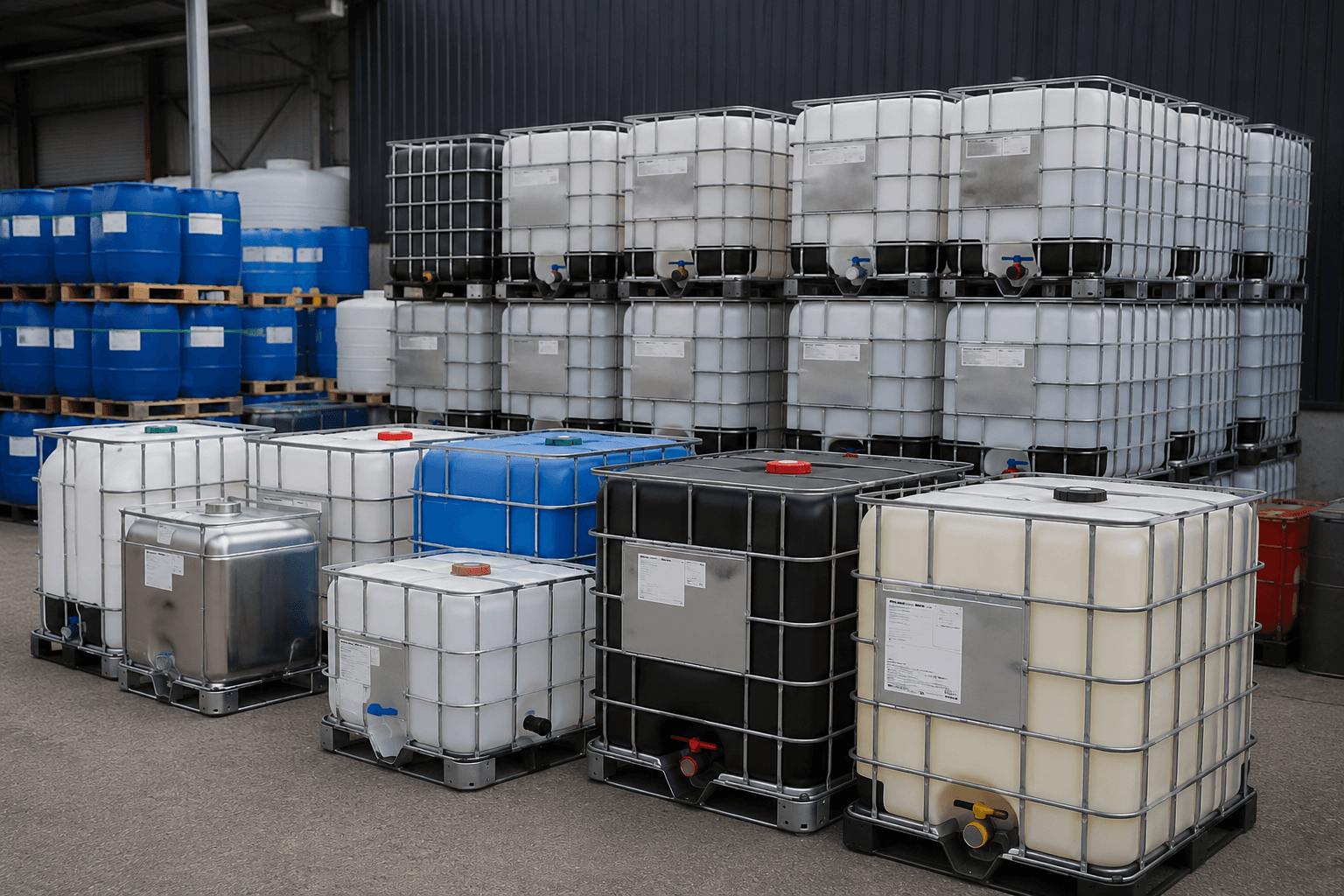
New vs. Used vs. Reconditioned
Understanding the three primary categories of IBC totes on the market is the foundation of making the right purchasing decision.
New IBC Totes
Brand-new IBCs direct from the manufacturer. Never filled, never used, with full manufacturer warranty and current UN certification. The bottle, cage, valve, lid, and pallet are all new. These are the premium option, offering guaranteed compatibility, no contamination risk, and the longest remaining service life.
Pharmaceutical, food-grade first use, regulated hazmat
Reconditioned IBCs
Reconditioned IBCs have been professionally cleaned, inspected, and restored to like-new functional condition. At a true reconditioning facility, this typically means the inner HDPE bottle has been replaced entirely with a new one ("rebottled"), the cage has been inspected for structural integrity, the valve and lid have been replaced, and the pallet has been repaired or replaced as needed. The result is a container with a new interior that performs identically to a new IBC.
Most industrial uses, chemical storage, water, non-food applications
Used IBC Totes
Used IBCs are containers that have been previously filled and used, then cleaned to varying degrees and sold as-is. The original bottle, cage, valve, and pallet are all from the original manufacturing run. Condition varies widely — from nearly new containers that held a single, benign product to heavily worn units that have been through multiple use cycles. Prior product history is a critical consideration when buying used IBCs.
Water storage, rainwater, non-food agricultural, general non-critical storage
Getting the Best Price on IBC Totes
IBC pricing is more negotiable than most buyers realize. Understanding the dynamics of the market gives you leverage to secure better deals.
Volume Leverage
Suppliers offer the best per-unit pricing on larger orders. Even if you do not need 50 units today, committing to a volume over time through a standing order or partnership agreement can unlock volume pricing. Ask about quarterly commitments rather than one-time bulk buys.
Timing Your Purchase
IBC demand is seasonal. Spring and summer bring peak demand from agricultural customers, which tightens supply and pushes prices up. Fall and winter are typically softer periods when suppliers are more willing to negotiate. If your needs are flexible, buying during off-peak months can save 10-15%.
Bundling Services
If you both buy and sell IBCs, bundle your transactions. Suppliers give better pricing to customers who are also sources of used totes. The combined value of the relationship gives you more negotiating leverage than a one-way transaction.
Pickup vs. Delivery
If you have the ability to pick up containers from the supplier's facility, you eliminate the delivery charge — which can be $25-$75+ per container depending on distance and quantity. For local buyers, this is the simplest way to reduce your total cost.
Seasonal IBC Pricing Trends
Low demand period. Suppliers may have excess inventory from Q4. Best time to negotiate volume pricing and lock in long-term rates.
Agricultural demand ramps up. Supply tightens for standard 275-gallon HDPE IBCs. Order early to avoid shortages and premium pricing.
Highest demand period. Agricultural and construction industries at full capacity. Limited negotiation room. Plan ahead and order before peak if possible.
Demand drops as agricultural season ends. Suppliers looking to move inventory before year-end. Good opportunity for bulk purchases at reduced rates.
IBC Grade Definitions
The IBC industry uses a letter grading system to communicate the cosmetic and functional condition of used and reconditioned containers. While not universally standardized, these definitions reflect the most widely accepted criteria.
Grade A
Premium ConditionGrade A IBCs are in the best condition available on the secondary market. The bottle is clean and clear with minimal staining or discoloration. The cage is straight with no bent tubes, cracked welds, or significant rust. The valve operates smoothly, the lid threads properly, and the pallet is structurally sound with no cracking or deformation.
- •Bottle is clear to slightly hazy, no deep stains
- •Cage is straight, no bent uprights or crossbars
- •Labels may be present but are typically removed
- •Typically single-use containers or lightly used
- •Suitable for most applications including food-adjacent
Grade B
Standard ConditionGrade B IBCs show moderate signs of use but are fully functional. The bottle may have some staining, discoloration, or residual label adhesive. The cage may have minor cosmetic dings or surface rust but is structurally sound. All fittings are operational. Grade B containers represent the best balance of price and performance for most industrial applications.
- •Bottle may be stained or discolored but intact
- •Cage may have minor dents, no structural damage
- •Labels and residue may be present
- •Multi-use containers in good working order
- •Best value for non-food industrial applications
Grade C
Economy ConditionGrade C IBCs show significant wear and are sold at the lowest price point. The bottle may be heavily stained, yellowed, or have visible scuffing. The cage may have noticeable dents or surface oxidation. Fittings may be worn but still functional. These containers are suitable for non-critical storage where appearance does not matter and contents are not sensitive.
- •Heavy staining, yellowing, or opacity in the bottle
- •Cage dents, moderate rust, cosmetic damage
- •Fittings may be worn but operational
- •Not recommended for food or sensitive chemicals
- •Good for water catchment, non-potable storage, waste collection
Supplier Audit Checklist
Before committing to a supplier, use this checklist to verify they meet professional standards for IBC reconditioning and resale.
Facility & Operations
Documentation & Service
Total Cost of Ownership & ROI Framework
The true cost of an IBC extends far beyond the purchase price. A comprehensive ROI analysis should account for all costs over the container's useful life to determine which option delivers the best value for your specific application.
Components of Total Cost of Ownership (TCO)
- Acquisition cost: The purchase price of the container
- Delivery / pickup cost: Transportation to your facility
- Setup and integration: Adapters, fittings, or modifications needed
- Maintenance: Valve replacements, gasket changes, cleaning between uses
- Downtime costs: Lost production if containers fail prematurely
- Disposal / end-of-life: Waste hauling fees or recycling costs
- Administrative overhead: Time spent ordering, tracking, and managing containers
Maintenance Cost Projections
Over the life of an IBC, expect to invest approximately $15-$30 in maintenance per use cycle. This includes valve replacements ($8-$15 each, typically needed every 2-3 cycles), gasket replacements ($3-$5 each cycle), and cleaning costs if you are reconditioning in-house. For a reconditioned IBC that costs $150 and lasts 5 use cycles with $25/cycle maintenance, the total cost is $275 over 5 uses, or $55 per use. Compare this to a new IBC at $300 that lasts 7 cycles with $20/cycle maintenance: total $440 over 7 uses, or $63 per use. The reconditioned option delivers 13% lower cost per use in this scenario.
ROI Calculation: Reconditioned vs. New
For a business purchasing 100 IBCs per year:
- New IBCs (100 x $300): $30,000 annual acquisition cost
- Reconditioned IBCs (100 x $150): $15,000 annual acquisition cost
- Annual savings: $15,000 (50% reduction)
- 5-year savings: $75,000 in acquisition costs alone
- Environmental bonus: 5,000 lbs of plastic and 7,500 lbs of steel diverted from virgin production annually
Add in the revenue from selling your used totes back to a reconditioning facility (typically $10-$30 per tote depending on condition), and the economic case for reconditioned IBCs becomes even stronger.
Quality Certification Verification
When evaluating a supplier's quality claims, ask for documentation. A reputable supplier should be able to provide: written inspection criteria and pass/fail standards, documented cleaning protocols by prior-content type, records of wastewater testing and discharge compliance, evidence of staff training on IBC handling and reconditioning, and references from long-term customers in your industry. If a supplier cannot produce this documentation, their quality claims are unverifiable and should be treated with caution.
What to Look For When Inspecting Used IBCs
Bottle Inspection
Check for cracks and crazing
Look for any visible cracks, stress marks, or crazing (fine network of surface cracks). Pay special attention to the base and corners where stress concentrates.
Assess staining and discoloration
Mild staining is cosmetic. But deep, uniform discoloration can indicate prolonged exposure to aggressive chemicals that may have compromised the HDPE.
Smell the interior
Open the lid and smell the inside. Residual chemical odors indicate incomplete cleaning or product that has permeated the HDPE. Strong odors are a red flag for food or sensitive applications.
Check UV degradation
IBCs stored outdoors without UV protection become brittle over time. Tap the bottle firmly — if it sounds thin or feels chalky to the touch, the HDPE is degraded.
Verify the date code
Find the manufacture date molded into the bottle. HDPE bottles older than 5 years should be scrutinized carefully. For hazmat use, the 5-year rule is mandatory.
Cage, Valve & Pallet
Inspect cage uprights
Look for bent, bowed, or crushed vertical tubes. Any cage deformation reduces stacking capacity and indicates potential forklift damage or overloading in the container's history.
Check weld points
Examine where horizontal bars meet vertical tubes. Cracked or broken welds are structural failures that cannot be easily repaired and compromise the entire cage's integrity.
Test the valve
Open and close the discharge valve several times. It should move smoothly without excessive force. Check the valve seat for damage and ensure the dust cap threads properly.
Examine the pallet
Check for cracked plastic, bent steel runners, or split wood. The pallet bears the entire loaded weight and must be in good condition. Wobbly or unstable pallets are a safety hazard.
Verify UN markings
The data plate should be legible with a valid UN marking. If you need the IBC for hazmat transport, verify the packing group rating and confirm the container is within its certification period.
Understanding IBC Tote Pricing
IBC pricing varies significantly based on condition, age, material, size, and market conditions. Understanding the pricing landscape helps you negotiate effectively and recognize when a deal is genuinely good versus when it is too good to be true.
Typical Price Ranges (275-Gallon HDPE)
- New from manufacturer: $200-$400+ depending on configuration, valve type, and pallet material. Custom specifications add to cost.
- Reconditioned (rebottled): $120-$200. New inner bottle, inspected cage, new fittings. The best value for most applications.
- Used Grade A: $100-$175. Clean, lightly used, structurally sound. Price varies by prior product and age.
- Used Grade B: $75-$125. Moderate wear, fully functional. The workhorse of the secondary IBC market.
- Used Grade C: $40-$75. Heavy wear, suitable for non-critical applications only.
Factors That Affect Price
- Prior contents: IBCs that held food-grade products command higher prices than those that held industrial chemicals
- Age: Newer containers are worth more — both because of remaining service life and regulatory compliance
- Pallet type: Steel pallets add $15-$30 over HDPE pallets on used totes
- Quantity: Bulk purchases (10+ units) typically receive 10-20% volume discounts
- Season: Demand peaks in spring and summer for agricultural applications, which can affect pricing
- Delivery: Pickup vs. delivery affects total cost. Local pickup eliminates shipping charges that can add $25-$75+ per container
Total Cost of Ownership
Do not evaluate IBC purchases on sticker price alone. A $100 used IBC that lasts two years costs $50/year. A $175 reconditioned IBC that lasts five years costs $35/year. A $300 new IBC that lasts seven years costs $43/year. And a $3,000 stainless steel IBC that lasts twenty years costs $150/year — but over those twenty years, you would have purchased and disposed of four or five HDPE units. Factor in disposal costs, downtime from failures, and the administrative overhead of more frequent purchasing cycles, and the "expensive" option often proves to be the most economical.
Red Flags to Watch Out For
Not every IBC seller operates with the same standards. Watch for these warning signs that indicate a supplier may not be providing the quality or honesty you deserve.
Unknown Prior Contents
If a supplier cannot tell you what was previously stored in a used IBC, that container could have held anything from food syrup to hazardous waste. For any application beyond basic non-contact storage, prior contents must be documented.
No Physical Facility
Brokers who buy and resell without ever physically inspecting or processing the IBCs cannot guarantee quality. A legitimate reconditioning operation has a physical facility you can visit. Online-only sellers with no verifiable address are risky.
Prices Far Below Market
If reconditioned IBCs are priced at used-grade levels, the reconditioning process is likely minimal. Proper reconditioning (new bottle, new valve, inspection) costs real money. Suspiciously low prices usually mean corners are being cut.
No Return Policy
A supplier who will not accept returns on defective containers has no incentive to maintain quality. Any reputable supplier should offer at least a short-term guarantee against leaks, defective valves, and structural failures.
Painted or Coated Bottles
Some sellers paint or coat used HDPE bottles to make them appear newer. This practice hides staining, discoloration, and UV damage. Legitimate suppliers clean containers; they do not paint over problems. If an IBC bottle is opaque or has an unusual surface finish, investigate further.
Missing or Altered Date Codes
Date codes should be clearly visible and unaltered. Scratched-out dates, covered data plates, or claims that "the date does not matter" are serious red flags. The manufacture date is essential for determining the container's age and compliance status.
Storage & Handling Tips
Indoor Storage
Store IBCs on a level, dry surface away from direct sunlight. Ensure adequate ventilation if storing volatile products. Maintain clear access aisles for forklift traffic. Use secondary containment (spill pallets or bermed areas) when storing chemicals.
Outdoor Storage
If outdoor storage is unavoidable, use UV-protective covers or opaque tarps to shield HDPE bottles from direct sunlight. Position IBCs on a paved or gravel surface, not bare soil. Ensure drainage away from the storage area and provide secondary containment as required by local regulations.
Forklift Handling
Always lift IBCs by the pallet, never by the cage. Center the forks fully under the pallet before lifting. Keep the load low during transport. Do not push IBCs across the floor — this damages the pallet and can compromise the cage connection. Train operators on the specific characteristics of IBC handling.
Temperature Considerations
HDPE IBCs are rated for temperatures from approximately -40°F to 150°F. Freezing conditions can cause product expansion that damages the bottle. Extreme heat accelerates UV degradation and can soften the HDPE. If your application involves temperature extremes, stainless steel IBCs are the safer choice.
Ready to Purchase?
Rochester IBC carries a full inventory of new, used, and reconditioned IBC totes in multiple sizes and configurations. Our team will help you find the right container for your application at the right price.