IBC Cleaning & Reconditioning Services
Transform used IBC totes into like-new condition. Our multi-stage cleaning process removes residues, odors, and contaminants. Our reconditioning service replaces worn components and restores structural integrity. Every unit is quality-tested before release.
Request Cleaning or Reconditioning
Fill in the details and we'll get back to you within 24 hours.
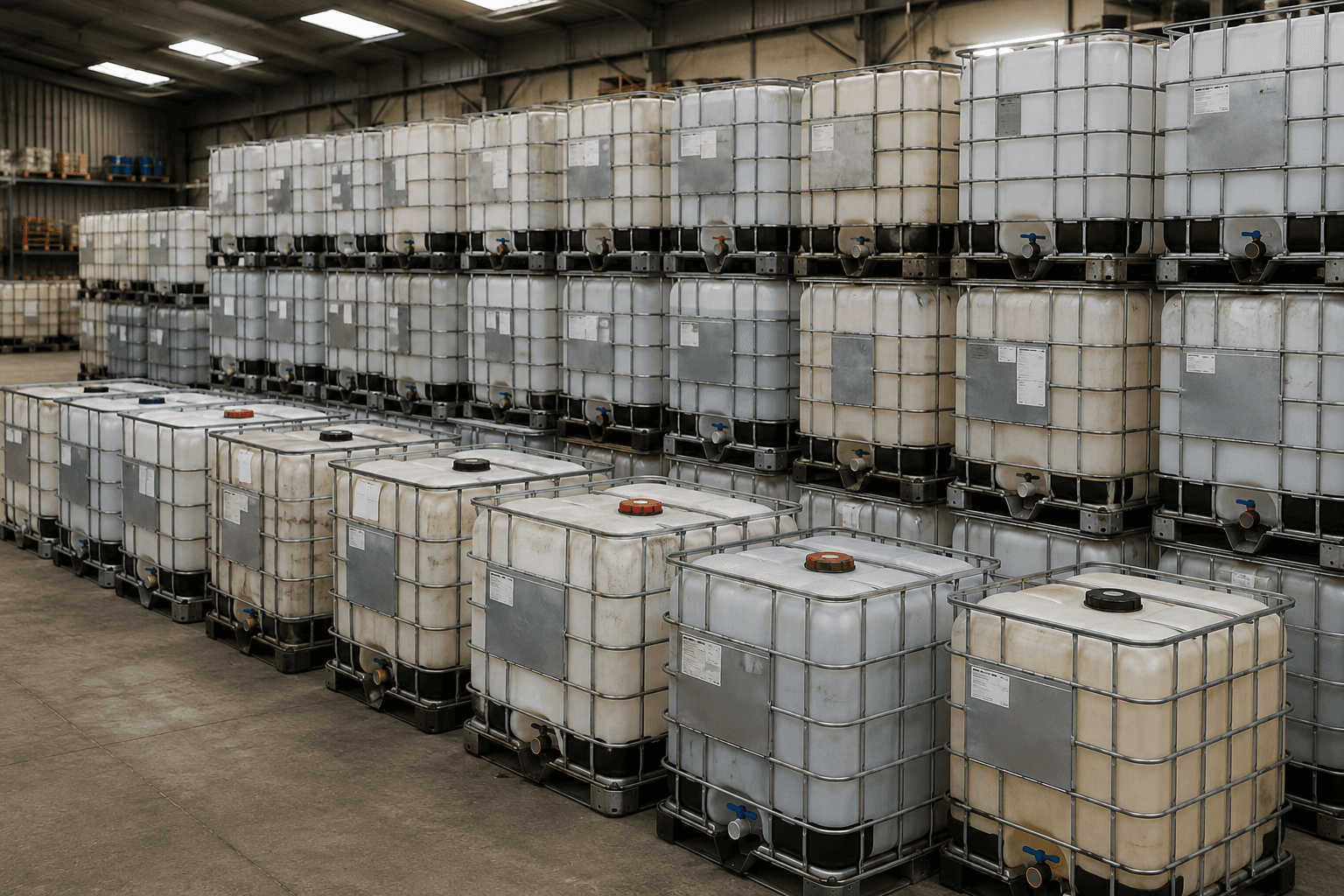
IBCs staged for cleaning in our facility. Each unit goes through a multi-stage process before returning to service.
Our Cleaning Process
Every IBC that enters our cleaning line goes through a rigorous multi-stage process designed to eliminate residual contents, remove odors, and prepare the container for its next use. Our protocol meets or exceeds industry standards for container cleaning, including food-grade sanitization when required.
Initial Drain & Inspection
Every IBC is fully drained of residual contents. Remaining product is captured and managed according to its material type: recyclable liquids are collected for proper processing, and hazardous residues are handled per EPA guidelines. A visual and structural inspection determines the cleaning protocol required.
- Complete drainage of residual contents
- Material characterization of residues
- Structural integrity assessment
- Cleaning protocol assignment
Hot Water Pressure Wash
The IBC bottle interior is blasted with high-pressure hot water at 160-180 degrees Fahrenheit. This stage removes the bulk of residual material, dissolves water-soluble contaminants, and breaks up biofilm or dried deposits. Exterior surfaces of the bottle, cage, and pallet are pressure washed simultaneously.
- 160-180°F water temperature
- 2,000+ PSI pressure application
- Interior and exterior coverage
- Effective on oils, syrups, and water-soluble residues
Chemical Rinse
Following the hot water wash, a chemical cleaning solution is applied to neutralize remaining residues. The specific chemical agent is matched to the prior contents of the IBC: alkaline cleaners for organic residues, acid rinses for mineral deposits, and solvent washes for petroleum-based products. Contact time and concentration are carefully controlled.
- Chemical agent matched to prior contents
- Alkaline, acidic, or solvent-based options
- Controlled concentration and contact time
- Neutralizes odors and staining compounds
Triple Rinse Protocol
Three consecutive fresh water rinses remove all traces of cleaning chemicals and any remaining residues. Each rinse is drained completely before the next begins. Rinse water is tested after the final pass to verify cleanliness. This triple rinse protocol is the industry standard for preparing containers for reuse, especially for food-grade applications.
- Three consecutive fresh water rinses
- Complete drain between each cycle
- Final rinse water quality testing
- Industry standard for food-grade prep
Food-Grade Sanitization
For IBCs destined for food, beverage, or pharmaceutical use, we add a dedicated sanitization stage after the triple rinse. FDA-approved sanitizing agents are applied at precise concentrations, followed by a final potable water rinse. The container is then sealed and labeled with cleaning documentation.
Food-grade cleaning is only performed on IBCs with verified food-safe prior contents. We never clean a former chemical container and certify it as food-grade. Traceability and integrity of the food-grade designation is non-negotiable.
Cleaning Chemistry Details
Effective IBC cleaning is not a one-size-fits-all process. The chemical agents, concentrations, temperatures, and contact times must be matched to the specific residue being removed. Here is how our chemistry works for the most common prior-contents categories.
Organic Residues (Oils, Syrups, Juices)
Treated with hot alkaline detergent solutions (sodium hydroxide-based) at concentrations of 2-5% at 150-170°F. Alkaline chemistry saponifies fats and oils, dissolving them into water-soluble compounds. Contact time of 15-30 minutes followed by the triple rinse cycle. Effective on food-grade oils, syrups, juice concentrates, and plant-based extracts.
Mineral Deposits & Scale
Treated with acidic solutions (phosphoric or citric acid-based) at 1-3% concentration at 120-140°F. Acid chemistry dissolves mineral scale, hard water deposits, and inorganic residues. Commonly needed after lime, calcium, or mineral-based products. Followed by a neutralizing rinse before the triple rinse to ensure no acid residue remains.
Petroleum & Solvent Products
Treated with specialized hydrocarbon solvent washes or high-concentration surfactant solutions. These agents emulsify petroleum residues, lubricants, and solvent traces, allowing them to be rinsed away with hot water. Additional ventilation and drying time is built into the protocol to ensure complete evaporation of volatile organic compounds.
Adhesives & Resins
Among the most challenging residues to remove. We use targeted solvent applications (ketone or ester-based) combined with extended hot water exposure and mechanical agitation. Adhesive residues on bottle interiors may require multiple cleaning cycles. Some heavily contaminated bottles are replaced rather than cleaned if residue cannot be fully removed.
Paint & Coatings
Water-based paints respond to hot alkaline washes. Solvent-based paints and coatings require aggressive solvent treatment. Dried or cured paint residue is the most difficult to remove and may result in bottle replacement rather than cleaning. We assess each container individually and recommend the most cost-effective approach.
Food-Grade Sanitization Agents
For food-grade certification, we use FDA 21 CFR 178.1010 compliant sanitizers: quaternary ammonium compounds (quats) at 200 ppm or peracetic acid (PAA) at 80 ppm. These agents are proven effective against bacteria, mold, yeast, and biofilm. Final rinse with potable water reduces sanitizer residue to below detectable levels.
FDA Food-Grade Sanitization Protocols
Our food-grade sanitization process is designed to meet FDA requirements for containers used in food, beverage, and pharmaceutical applications. Every step is documented and traceable.
Pre-Qualification Criteria
Not every IBC qualifies for food-grade certification. Before any cleaning begins, containers must pass these pre-qualification checks. We never certify a container as food-grade unless it meets every criterion.
- Prior contents must be verified as food-safe through documentation or SDS review
- Bottle must be free of cracks, holes, and structural compromise
- No history of hazardous chemical, petroleum, or toxic substance storage
- Manufacturing date within acceptable age range (typically under 5 years)
- HDPE material type confirmed (no cross-contamination with other plastics)
- No persistent odor detectable after initial hot water wash
- Label and adhesive residue must be fully removable
Sanitization Protocol Steps
Step 1: Pre-Clean
Standard hot water pressure wash and alkaline cleaning to remove all visible residue and organic material. This prepares the surface for effective sanitization.
Step 2: Triple Rinse
Three consecutive fresh water rinses to remove all cleaning chemical traces. Final rinse water tested for pH neutrality and clarity.
Step 3: Sanitizer Application
FDA-approved sanitizer (quaternary ammonium or peracetic acid) applied at precise concentration via automated dosing system. Full interior contact ensured through rotation.
Step 4: Contact Time
Minimum 2-minute contact time at required concentration. Temperature maintained at 60-80°F for optimal sanitizer efficacy. Timed and logged electronically.
Step 5: Final Potable Rinse
Potable (drinking water quality) rinse to reduce sanitizer residue to below FDA-permitted levels. Rinse water tested for residual sanitizer concentration.
Step 6: Seal & Document
Container is immediately sealed with tamper-evident cap. Certificate of cleaning attached with date, batch number, sanitizer type, and technician ID.
Cleaning Equipment & Infrastructure
Our cleaning facility is purpose-built for IBC processing. The equipment, infrastructure, and layout are designed for throughput, consistency, and environmental compliance.
Industrial Pressure Wash System
Hot water pressure wash system delivering 2,000+ PSI at 160-180°F. Heated by a 1-million BTU natural gas boiler. Interior wash nozzles mounted on rotating arms reach every surface inside the IBC bottle. Exterior nozzles clean cage, pallet, and all outer surfaces simultaneously.
Chemical Dosing Station
Automated chemical dosing system with programmable concentration control. Stocks alkaline, acidic, and solvent-based cleaning agents. The system selects and doses the correct chemical based on the cleaning protocol assigned during inspection. Concentration is verified by inline conductivity sensors.
Triple Rinse Station
Dedicated triple rinse station with fresh water supply and individual drain capture for each rinse cycle. Final rinse water is tested in real-time for pH, conductivity, and turbidity. Any unit that does not meet rinse water quality standards is recycled through the rinse cycle until it passes.
Sanitization Chamber
Enclosed sanitization chamber for food-grade processing. FDA-approved sanitizer is applied via automated spray system at precisely controlled concentrations. Contact time is timed electronically and logged. Temperature-controlled environment maintains optimal sanitizer efficacy.
Wastewater Treatment System
All wash water, rinse water, and residual liquids are captured in a closed-loop system. Oil-water separators, pH adjustment tanks, and filtration systems treat wastewater before discharge to the municipal sewer system under our SPDES permit. Zero discharge to storm drains.
Drying & Staging Area
Heated drying area where cleaned IBCs are air-dried before final inspection. Positive air pressure prevents contamination from airborne particles. Cleaned containers are staged in a designated clean zone separate from incoming dirty units to prevent cross-contamination.
Quality Control Checkpoints
No IBC leaves our facility without passing a comprehensive quality check. Every cleaned and reconditioned container goes through a multi-point inspection that verifies cleanliness, structural integrity, and functional performance.
Our quality control process is designed to catch any issue before the container reaches you. If a unit fails any test, it is either retreated or redirected to our recycling stream. We do not ship marginal product.
Each stage of the cleaning process has its own quality checkpoint. This means problems are caught early, not at the end of the line when rework is expensive. Our reject rate at final inspection is under 2% because most issues are resolved during earlier stages.
For food-grade containers, additional testing includes olfactory inspection (smell test by trained personnel), visual clarity assessment of the bottle, and verification of all food-safe documentation. These units are sealed immediately after passing and labeled as food-grade certified.
Quality Check Points:
Checkpoint 1: Post-Drain Inspection
Before any cleaning begins. Verifies structural soundness and assigns cleaning protocol. Rejects containers with unrepairable damage.
Checkpoint 2: Post-Wash Verification
After hot water pressure wash. Checks that bulk residue is removed and identifies any areas needing additional attention or chemical treatment.
Checkpoint 3: Rinse Water Testing
After triple rinse. Tests final rinse water for pH, clarity, and conductivity. Containers that fail are re-rinsed until water quality standards are met.
Checkpoint 4: Visual Inspection
Bottle clarity, staining, label residue, cage condition, pallet integrity. Every surface is examined under bright lighting.
Checkpoint 5: Leak Test
Containers are filled and pressurized to verify zero leakage from the bottle, valve, lid, and all seals. Any leak = fail.
Checkpoint 6: Valve Function Test
Opening, closing, and flow rate are tested. Valves must operate smoothly without dripping in the closed position.
Checkpoint 7: Odor Assessment
Trained inspectors verify that no residual odors remain. Critical for food-grade and sensitive applications. Containers with detectable odor are re-cleaned.
Checkpoint 8: Documentation Review
Prior contents records, cleaning logs, and component replacement records are verified and filed for traceability before the unit is cleared for sale.
Turnaround Time Guarantees
We understand that container downtime costs your business money. That is why we commit to specific turnaround times for every cleaning service level and communicate proactively if any delays arise.
Basic Cleaning
Hot water pressure wash plus chemical rinse. Suitable for non-food industrial reuse. Includes label removal and exterior wash.
Guaranteed maximum: 5 business days. If we exceed this window, you receive a 10% discount on the cleaning fee. Rush service available for 1-day turnaround at premium rates.
Full Clean + Recondition
Complete cleaning protocol plus valve, gasket, and component replacement as needed. Quality tested and graded.
Guaranteed maximum: 7 business days. Parts availability may extend timeline for unusual valve types. We notify you of any delay within 24 hours of identification.
Food-Grade Certification
Full cleaning, triple rinse, food-grade sanitization, quality testing, and certification. Sealed and documented for food-safe use.
Guaranteed maximum: 10 business days. Additional time accounts for sanitization protocol, drying, testing, and certification documentation. No shortcuts on food-grade quality.
Volume Cleaning Programs
Businesses that regularly need IBC cleaning benefit from our volume programs. Whether you send us 10 containers a month or 100, we offer tiered pricing, priority scheduling, and dedicated account management. Set up a recurring cleaning program and never worry about container turnaround again.
Cleaning vs. Reconditioning
Clients often ask whether they need cleaning, reconditioning, or both. Here is a clear comparison to help you choose the right service for your containers.
Cleaning
Addresses the contents and interior condition of the IBC. Removes residual product, odors, staining, and biological contamination from the bottle interior and exterior surfaces.
What It Includes:
- Hot water pressure wash (interior + exterior)
- Chemical rinse matched to prior contents
- Triple fresh water rinse
- Label and adhesive removal
- Optional food-grade sanitization
- Rinse water quality testing
Best When:
The IBC is structurally sound with functional valve, gasket, and pallet, but needs to be cleaned of prior contents before its next use. Most cost-effective option for containers in good physical condition.
Reconditioning
Addresses the physical components of the IBC. Repairs, replaces, and restores structural and functional parts to extend the container's service life and ensure reliable performance.
What It Includes:
- Bottle replacement (new HDPE if needed)
- Valve replacement or rebuild
- Gasket and seal renewal
- Cage straightening and weld repair
- Pallet repair or replacement
- Lid and cap replacement
Best When:
The IBC has worn, damaged, or non-functional components that need repair or replacement. Often combined with cleaning for a complete restoration to like-new condition.
Most Clients Choose Both
Our most popular service is the combined Clean + Recondition package. This gives you a container that is both internally clean and externally restored, essentially like-new at a fraction of the cost. We recommend this option for any IBC that will be used multiple additional times or resold to end users.
Reconditioning Services
Cleaning addresses what is inside the IBC. Reconditioning addresses the physical components. We repair, replace, and restore every part of the container to extend its service life and ensure reliable performance.
Bottle Replacement
When an IBC bottle is too stained, cracked, or warped to clean effectively, we replace it entirely. New HDPE bottles are fitted to the existing cage and pallet, giving the container a completely fresh start at a fraction of the cost of a new IBC.
- New HDPE bottle installation
- Proper fitment to existing cage
- UV-stabilized material
- Food-grade bottles available
Valve Replacement
Valves are the most commonly replaced IBC component. We stock butterfly valves, ball valves, and cam-lock fittings in standard 2-inch sizes. Worn, leaking, or incompatible valves are removed and replaced with new units that match your system requirements.
- 2" butterfly valve (standard)
- 2" ball valve option
- Cam-lock fitting conversion
- Leak-tested after installation
Cage Repair
Dented, bent, or corroded steel cages are straightened, welded, and treated. Minor structural damage is repaired in-house using specialized jigs and welding equipment. Severely damaged cages are replaced entirely or sent to our steel recycling stream.
- Straightening and reshaping
- Weld repair for cracks
- Rust treatment and coating
- Full cage replacement option
Gasket Replacement
Gaskets deteriorate with age, chemical exposure, and repeated use. We replace lid gaskets, valve gaskets, and all sealing components as part of standard reconditioning. New gaskets ensure leak-free performance and proper seal integrity.
- Lid gasket replacement
- Valve seat gasket renewal
- EPDM and Viton options
- Chemical-compatible materials
Pallet Repair
Broken boards, cracked runners, and loose fasteners are replaced or reinforced. Wood pallets are repaired to support full container weight plus stacking loads. Composite pallets are inspected for cracks and structural compromise.
Label Removal
All previous labels, markings, and branding are removed from the bottle and cage. Adhesive residue is cleaned off. This prepares the IBC for new labeling and prevents confusion about prior contents.
Lid & Cap Service
Top fill lids are inspected for cracks, warping, and seal integrity. Damaged lids are replaced. Vented and non-vented cap options are available. All closures are tested for proper fit and seal.
Before & After: What to Expect
Here is what a typical IBC looks like before and after our cleaning and reconditioning process, broken down by the type of prior contents.
Food-Grade IBC (Juice/Syrup)
Before:
Sticky residue coating interior walls. Sweet odor. Amber or brown tinting from concentrated sugars. Labels from food manufacturer. Minor crystallized deposits near valve.
After:
Crystal-clear bottle interior with no visible residue, staining, or odor. FDA-sanitized and sealed. New gasket installed. Certificate of cleaning attached. Ready for food-grade reuse.
Industrial Chemical IBC (Detergent)
Before:
Foamy white residue in bottom third of bottle. Strong soap scent. Labels partially removed with adhesive residue. Valve has minor drip when closed. Cage has surface rust spots.
After:
Clean interior with no residue or foam. No detectable odor. All labels and adhesive removed. New valve installed and leak-tested. Cage rust treated and coated. Graded B, ready for industrial reuse.
Agricultural IBC (Fertilizer)
Before:
Green-tinted bottle from liquid fertilizer. Mineral deposits around valve opening. Strong ammonia odor. Cage has mud and debris. Wood pallet has one split runner board.
After:
Bottle cleaned to light green tint (within Grade B standard). Mineral deposits dissolved with acid rinse. Odor eliminated through chemical neutralization. Cage pressure-washed. Pallet runner replaced. Functional and ready for agricultural reuse.
Heavily Damaged IBC (End of Life)
Before:
Cracked bottle with visible UV degradation. Severely bent cage corner. Two broken pallet boards. Unknown prior contents. Not suitable for cleaning or reuse.
After:
Fully disassembled and recycled. HDPE bottle shredded into clean plastic flake (120 lbs recovered). Steel cage compacted for recycling (80 lbs). Pallet wood chipped for biomass. Certificate of Recycling issued to seller.
Why Clean & Recondition Instead of Buying New?
Save 60-80% vs. New
Cleaning and reconditioning a used IBC costs a fraction of purchasing a brand-new container. For most applications, the result is functionally identical.
Faster Than Ordering New
New IBC lead times can stretch to 4-8 weeks. We can clean and recondition your existing containers in under a week.
Reduce Waste Dramatically
Every reconditioned IBC is one less new container manufactured and one less old container in the waste stream. It is the single most impactful sustainability choice for bulk containers.
Maintain Your Supply
If you already own IBCs, cleaning lets you reuse your existing fleet instead of expanding your container inventory. Lower capital tied up in packaging.
Food-Grade Restoration
Containers that held food-safe products can be restored to food-grade condition through our certified sanitization process. No need to buy new food-grade IBCs.
Environmental Documentation
Every cleaning and reconditioning job is documented. Use our reports for your sustainability metrics, ESG reporting, and environmental compliance records.
Bring Your IBCs Back to Life
Whether you need a single IBC cleaned for reuse or a fleet of containers reconditioned for resale, Rochester IBC has the equipment, expertise, and commitment to quality that gets the job done right.